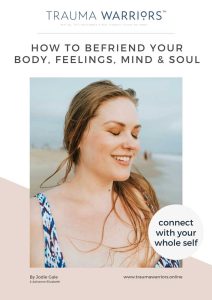
For over half of my life, I used to feel “crazy” around food – like it had the power to flip a switch in me and take over. Now I don’t. These days, I understand my relationship with food wasn’t proof that there was something wrong with me; it was communicating something important about what I was carrying, what I needed, and what I didn’t yet have words for.
My Story (And Why I Get It)
As a five-year-old, I’d stand next to the “fat” kid at school so I wouldn’t look fat (I wasn’t). At eight, I wore a T-shirt in the backyard pool so no one would see my body (again, I wasn’t “fat” – I was a child). By thirteen, I was living with bulimia and at war with my body.
I stayed stuck in that cycle until my mid-twenties. One day in London, after fainting on a Tube platform from not eating enough, I knew something had to change. I found a soul-centred psychotherapist, and that support became the beginning of a deeply challenging – and ultimately life-changing – journey into recovery and beyond.
A Non-Pathologising Lens
A dominant medical model often describes eating disorders as a disease or mental illness. My experience – personally and professionally – is different. I prefer a non-pathologising, holistic lens that honours the intelligence behind symptoms, rather than treating them as evidence that someone is “broken”. I’m not especially interested in labelling you (or you labelling yourself); I’m interested in understanding what’s happened, what the pattern is protecting, and what you’re needing now for your life to be different.
In my work, I meet courageous, creative women who have developed extreme strategies with food and body for a reason – often as a way of managing biographical, existential and/or spiritual trauma and crisis (Gale, 2008, 2010). When we approach these strategies with curiosity and compassion, we can listen for their purpose, loosen the shame, and support new choices to emerge – choices that are steadier, kinder, and more life-giving.
What I Do (And How I Work)
For over 25 years, I’ve been supporting women who feel tangled up with food, weight, body image, and the exhausting push–pull between “being good” and “losing control”. Many have tried willpower, diets, rules, programs, self-criticism, and most recently GPL-1 medications such as Ozempic, Mounjaro and Wegovy – only to find the cycle returns.
My work is grounded in Soul-Centred Psychotherapy and Eating Psychology, including Dynamic Eating Psychology™ and Mind Body Nutrition™. Practically, this means we explore your relationship with food and body with compassion and honesty, paying attention to patterns, triggers, nervous system cues, and the meanings that food and body have come to hold. The aim isn’t to pathologise you – it’s to understand what your strategies have been doing for you, so you can develop new ways of meeting those needs.
This work can help with
- Yo-yo dieting, fad dieting, or chronic dieting
- Weight cycling with GPL-1 medications (e.g Ozempic)
- Obsessive tracking (points, calories, macros)
- Body image distress, body shame, and harsh self-talk
- Using food to soothe, numb, manage, or suppress feelings
- Perfectionism and the sense of never being “good enough”
- Patterns such as restriction, orthorexia, binge eating, bulimia, or compulsive exercise
- Black-and-white thinking about “good/bad” foods and “clean/unclean” eating
- Health and wellbeing concerns impacted by stress, eating patterns, and body relationship (including digestion, fatigue, illness and immunity)
- The underlying trauma you may be experiencing such as attachment, complex and developmental trauma and childhood emotional neglect (CEN).
If This Resonates
If any part of this resonates, you’re not alone.
You might like to reflect on this question: what if your relationship with food isn’t a personal failing, but an intelligent adaptation to what you’ve lived through?
Change is possible. With the right support and a compassionate lens, many women find they can come home to themselves – around food, in their bodies, and in their lives.