Some time ago I was interviewed by Jared Levenson on the Eating Enlightenment Podcast about overcoming eating trauma. Although the episode is no longer available online, I wanted to share some of the key ideas from that conversation here.
In the interview we discussed emotional eating, chronic dieting, body image struggles and eating disorders, and how trauma, particularly childhood emotional neglect, often sits at the root of these patterns.
Below are some of the questions we explored.
Q: What draws women to your approach to recovery from body image problems and eating disorders?
Women looking for recovery from body image problems, yo yo dieting, chronic dieting and eating disorders are drawn to my approach because I provide a non pathologising, holistic, forward thinking and soulful perspective for transformation and growth.
Many women who come to see me have already tried numerous diets, treatments, or behaviour based approaches that focus solely on food or weight. What they are often searching for is a deeper understanding of why their relationship with food developed the way it did.
My work looks at the underlying emotional and relational experiences that shape our coping mechanisms with food and body image.
Q: What do you mean by a non pathologising approach?
Psychopathology is used in the DSM and refers to the scientific study of mental disorders.
So when I say my approach is non pathologising, what I mean is that whether I am working with chronic dieting, emotional eating, extreme clean eating or orthorexia, or clinically diagnosable eating disorders such as binge eating, bulimia or anorexia, I do not primarily see these as mental illnesses or mental disorders.
Instead, I view them as ways of coping with childhood emotional neglect and complex trauma.
When I speak about complex trauma, I include attachment trauma which refers to early attachment injuries, developmental trauma which refers to the arrested development of the self, and the emotional, physical, psychological, relational, cultural and spiritual neglect or abuse that can occur in early environments.
When someone is labelled with a mental illness or mental disorder without understanding their life story, it can place a kind of glass ceiling on their recovery. It reduces their experience to a diagnosis and misses the whole person, their history and their wholeness.
Q: Why is a holistic approach important when working with disordered eating?
A holistic approach means taking the whole person into consideration.
This includes the body, feelings, mind, sexuality and spirituality.
A medical model approach typically works primarily with thoughts and behaviours. While that can be helpful, it often does not address the deeper relational and emotional aspects of eating disorders.
In my work I explore not only someone’s history but also what is happening here and now in the room, as well as the potential that is inherent within each of us.
Healing is not only about understanding the past. It is also about reconnecting with parts of ourselves that may have been lost, hidden or suppressed.
Q: What do you mean by a forward thinking approach to symptoms like emotional eating?
A forward thinking approach asks a different question about symptoms.
Instead of seeing emotional eating or binge eating simply as problems to eliminate, we ask: What is this symptom calling for us to awaken to?
All symptoms carry value, meaning and purpose.
For example, emotional eating may be calling someone to pay attention to their feelings. It may be asking them to learn how to regulate emotions or to recognise a need for soothing.
Sometimes an eating disorder has been an attempt to separate and individuate from a family system.
Sometimes a larger body becomes the only way someone knows how to hide, protect themselves or take up space in the world.
Sometimes an anorexic body becomes the only way someone knows how to disappear or not take up space.
Extreme clean eating may be the only way someone knows how to feel good enough or superior.
Food can also become a way of suppressing creativity, pleasure or sexuality, or managing anger that someone does not feel safe expressing.
Our work in recovery is to recognise the call behind the symptom and begin to actualise that in our lives.
Instead of using food or our bodies to meet these needs, we begin to meet them in healthier and more relational ways. This includes both our internal relationship with ourselves and our external relationships with others.
At a foundational level we are working with human needs such as safety, belonging, love and esteem, as described in Maslow’s hierarchy of needs. From there we can begin moving toward our higher needs and potential.
Q: You also talk about a soulful perspective in recovery. What does that mean?
Many people struggling with eating concerns feel spiritually empty or disconnected from themselves. In that sense eating disorders are not only psychological.
They can also reflect a kind of spiritual bankruptcy.
We need to learn to see ourselves with bifocal vision. On one level we have an ego or personality, and on another level we have a soul. At our core, regardless of what we have been through in life, there is a part of us that remains whole and unbroken. That part of us needs attention, care and nourishment.
I am a Carolyn Costin Eating Disorder Coach and Carolyn uses the term soul self.
One part of us may be caught in the eating disorder self, while another part represents the healthy self or soul self.
The part we feed becomes stronger.
Feeding the soul involves turning toward our inner world rather than superficial concerns.
We organise our lives around what truly moves us.
This might include listening to music, spending time in nature, swimming in the sea, standing on the top of a mountain, connecting with Country and the land, watching the moon rise or a sunset, or engaging creativity through art journaling and other forms of expression.
These experiences reconnect us with something deeper than food, weight or appearance.
Links mentioned in the interview
TraumaWarriors.Online
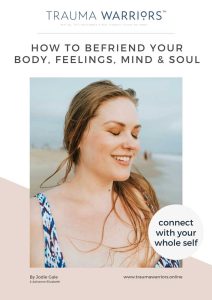
Free eBook: How to Befriend Body, Feelings, Mind & Soul
Podcast for Emotional Eating, Trauma & Not Feeling Good Enough
Maslow’s Hierarchy of Needs
Dante’s Divine Comedy