Many of us move through life without fully understanding what we are feeling or what we need. We may feel overwhelmed, disconnected, or caught in patterns we can’t quite make sense of, especially in our relationship with food, our body, or ourselves.
When our feelings and needs are not seen, heard, or validated in childhood, we often grow up disconnected from them. Instead of knowing what we feel or need, we may search outside of ourselves to fill that gap. This can show up in many ways, including emotional eating, binge eating, bulimia, addiction, overspending, or other self-destructive or self-protective behaviours. For some, this pattern develops within family systems where a parent’s needs dominated, such as in narcissistic families, or where a parent was unwell and the child adapted by disconnecting from their own inner world. Over time, this can lead to a deep sense of confusion, emptiness, or the feeling of not being good enough, often accompanied by a harsh and critical way of relating to ourselves.
Learning to recognise and name our feelings and needs is therefore a foundational part of self-discovery and healing. Non Violent Communication (NVC) offers a compassionate and practical framework for reconnecting with this inner landscape. It invites us to meet ourselves with kindness rather than judgement, and to begin developing a more understanding and caring relationship with our inner world. In this way, NVC can play an important role in trauma recovery and in healing patterns such as disordered eating, addiction, and other ways we have learned to cope. It provides a gentle roadmap for being with (a Circle of Security term) our feelings and needs with compassion, and for learning how to express them, both within ourselves and in our relationships with others.
What is Non Violent Communication (NVC)?
Non Violent Communication, developed by Marshall B. Rosenberg, is a communication framework designed to cultivate empathy, compassion, and understanding, both within ourselves and in our relationships. At its core, NVC recognises that all human beings share common feelings and needs. When we learn to acknowledge and express these with awareness and compassion, we begin to soften judgement, deepen connection, and relate to ourselves and others in more humane and respectful ways. The feelings and needs component of NVC offers a structured yet flexible way of making sense of our emotional world. It supports us to move away from criticism and blame, and towards curiosity and care, allowing for more compassionate communication.
What are Feelings?
In Non Violent Communication, feelings are understood as indicators of our emotional state. They reflect how we are responding internally to whether our needs are being met or unmet. Feelings are distinct from thoughts, interpretations, or judgements. Rather than saying “I feel like no one cares,” NVC encourages us to identify the underlying feeling, such as sadness, loneliness, or disappointment. This shift supports us to relate to ourselves with greater clarity and compassion. Developing the ability to recognise and name our feelings builds self-awareness and emotional literacy. It also creates space for self-compassion, as we begin to acknowledge our experience without criticism or shame. When we can express our feelings in this way, we also invite empathy from others. In this sense, feelings become a bridge, supporting compassionate connection within ourselves and in our relationships.
What are Needs?
In Non Violent Communication, needs are the fundamental human requirements that give rise to our feelings, thoughts, and behaviours. They include physical, emotional, relational, psychological, and spiritual needs. Marshall Rosenberg identified that these needs are universal. While the strategies we use to meet them may differ, the needs themselves are shared across all people. These include needs for connection, safety, autonomy, understanding, meaning, and belonging. NVC encourages us to recognise and express our needs with compassion rather than shame. Many people have learned to ignore, minimise, or judge their needs, particularly if they were not supported in childhood. Reclaiming our needs is therefore a deeply compassionate act of self-connection. From a somatic perspective, our bodies often signal when needs are unmet, through sensations such as tension, discomfort, or collapse. By bringing awareness to these experiences, we deepen our connection to ourselves and develop a more integrated understanding of our inner world. As we learn to honour our needs, we also become more able to communicate them clearly and respectfully, supporting more compassionate and authentic relationships.
Coming Home to Your Feelings and Needs
When we have learned to disconnect from our feelings and needs, it is understandable that we seek other ways to cope. Emotional eating, disordered eating, addiction, and other behaviours often make sense when viewed through a compassionate lens, as attempts to meet needs that have not yet been recognised or supported. Non Violent Communication does not ask us to judge or eliminate these behaviours. Instead, it invites us to become curious about what they might be expressing, and to meet ourselves with compassion rather than criticism. As we begin to recognise our feelings, understand our needs, and relate to ourselves with care, something begins to shift. We are no longer searching outside of ourselves in the same way, because we are learning how to be in relationship with ourselves. Over time, this compassionate awareness supports greater choice, deeper connection, and a more grounded and authentic way of being, both within ourselves and with others.
Please visit How Expansive is Your Emotional Vocabulary? Feelings and Needs We All Have on the NVC website.
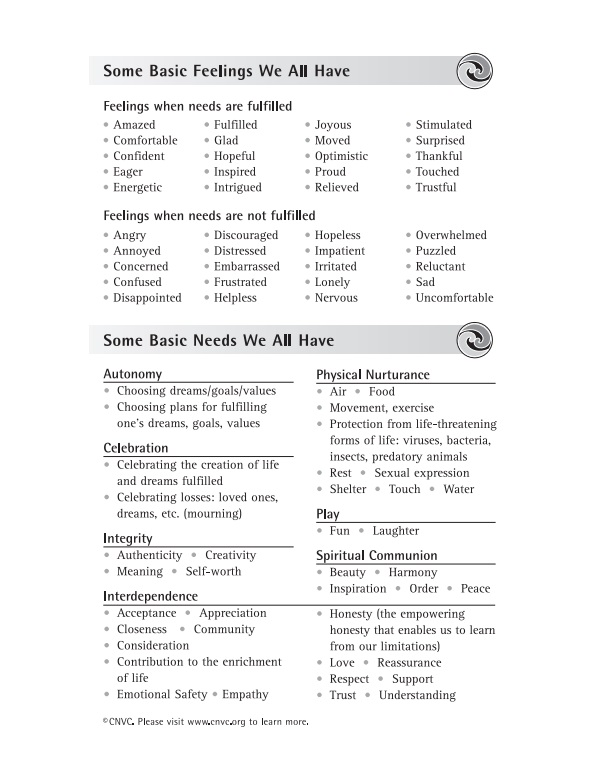
Content by PuddleDancer Press. Use of content okay with attribution. Please visit www.nonviolentcommunication.com to learn more about Non Violent Communication.